
www.industry-australia.com
17
'26
Written on Modified on
Flat RFID read/write head for tight spaces
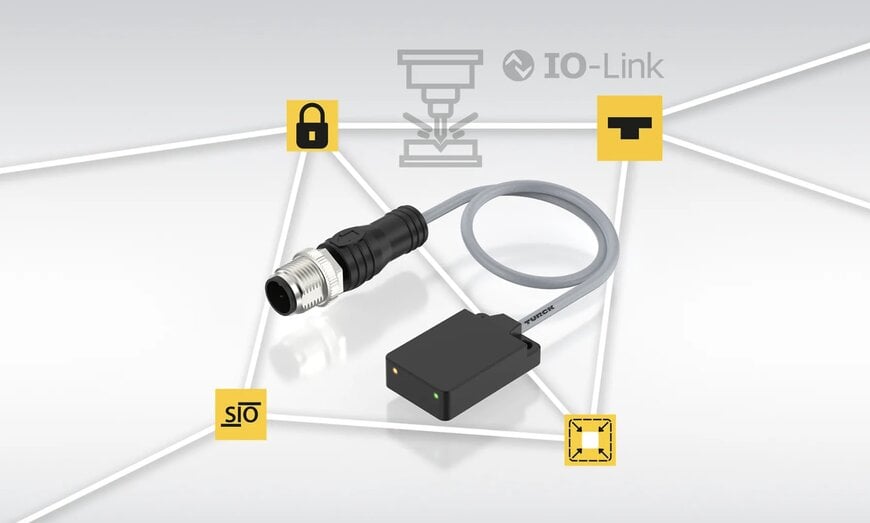
TURCK’s TN-Q30-IOL IO-Link read/write head detects small objects and tools with in-metal tags at an installation depth of just 8 mm.
www.turck.com
Automated manufacturing cells in semiconductor wafer handling, electronics assembly, battery production, and CNC tool management increasingly rely on decentralized workpiece and tool identification to verify process recipes and prevent machining errors. However, modern high-density machines, miniature transport shuttles, and spindle tool magazines leave minimal clearance for standard cylindrical M12 or M18 threaded barrel readers, whose axial length frequently interferes with moving carriers or adjacent tooling. Furthermore, deploying specialized miniature RFID heads often introduces engineering overhead when disparate readers require separate IO-Link Device Description (IODD) files, custom function blocks, or dedicated fieldbus gateways, complicating commissioning and maintenance across mixed production lines. Overcoming these mechanical and integration constraints requires low-profile rectangular RFID read/write heads that operate directly in metallic environments, support standardized plug-and-play IO-Link parameterization, and enable decentralized on-tag data storage.
Low-Profile Rectangular Form Factor and Unified IO-Link Integration
To enable automated identification where cylindrical threaded sensors cannot fit, TURCK introduced the TN-Q30-IOL2-0.15-RS4.41T, an ultra-compact RF read/write head equipped with a native IO-Link interface. Measuring just 32 × 20 × 8 millimeters, the flat rectangular housing fits directly inside tight machine enclosures, beneath narrow workpiece carriers, and adjacent to metallic tool holders where standard M12 or M18 barrel readers prove too long. The device complements TURCK’s existing IO-Link RFID lineup across the cylindrical TN-M18 and TN-M30 models and the larger TN-Q40 rectangular series.
Functionally aligned with TURCK’s broader IO-Link RF portfolio, the TN-Q30-IOL utilizes a single common IODD file across all TURCK IO-Link read/write heads, eliminating device-specific PLC programming changes when mixing housing geometries on a single machine. For rapid track-and-trace applications, operators can read unique tag identifiers (UIDs) or read and write user data bytes, configuring parameters directly through the web interface of a TURCK IO-Link master or via the TURCK Automation Suite (TAS). For basic presence or pass/fail verification without full cyclic fieldbus polling, the reader also supports Standard Input/Output (SIO) mode, triggering a discrete switching signal based on the outcome of an RFID read operation.
Decentralized Tool Data Management and IIoT Connectivity
In automated tool management and precision manufacturing lines—spanning semiconductor, electronics, photovoltaic, and battery cell production—the TN-Q30-IOL supports direct read/write operations on tags embedded flush inside metal tools and carriers. Rather than relying exclusively on centralized MES databases, critical lifecycle metadata—including cumulative operating hours, maximum permissible spindle speed, last maintenance date, and tool geometry type—can be written directly onto the tool’s RFID tag, with optional password protection to prevent unauthorized modification. Through the connected IO-Link master, TAS, and TAS Cloud, this decentralized asset telemetry remains accessible to upstream Industrial Internet of Things (IIoT) analytics and predictive maintenance platforms.
Additional Context
This section details technical specifications and competitive benchmarking not included in the original product announcement.
In industrial high-frequency (HF) RFID systems operating at 13.56 MHz under the ISO/IEC 15693 air-interface standard and IO-Link specification IEC 61131-9 (specifically the Smart Sensor Profile for RFID), mounting compact read/write antennas near metallic machine frames or reading tags embedded flush in steel CNC tool holders presents electromagnetic eddy-current challenges. Metallic surfaces detune the resonant LC circuit of standard inductive coupling coils and attenuate magnetic flux density, collapsing read ranges to zero unless the reader incorporates specialized ferrite shielding layers and tuned coil geometries matched to miniature transponder footprints. Over IO-Link COM2/COM3 links, cyclic process data handles high-speed UID acquisition and short user-memory transfers (typically 8 to 32 bytes per cycle) within deterministic scan times, while acyclic ISDU (Indexed Service Data Unit) channels manage larger multi-block memory reads, password authentication, and antenna power tuning without burdening the main PLC I/O image.
Within the compact industrial IO-Link RFID reader market, TURCK’s TN-Q30-IOL2-0.15-RS4.41T benchmarks directly against low-profile rectangular HF read/write heads from Balluff (BIS M-4008 and BIS M-4012 ultra-flat IO-Link heads), Pepperl+Fuchs (IQT1-F61 and F190 series compact IO-Link RFID readers), SICK (RFH505 and RFH510 compact HF interrogators), and IFM Electronic (DTE60x and DTE80x compact RFID units). While competitors such as Balluff and Pepperl+Fuchs offer well-established flat-pack IO-Link readers for pallet and tray tracking, TURCK differentiates its portfolio by standardizing on a single shared IODD across cylindrical (TN-M18, TN-M30) and rectangular (TN-Q30, TN-Q40) housings, pairing native SIO switching mode with seamless integration into the TURCK Automation Suite and TAS Cloud edge ecosystem. This combination allows machine builders to standardize PLC function blocks across varied mechanical mounting constraints while extending tool-level lifecycle data directly into cloud-based condition monitoring workflows.
Edited by Romila DSilva, Induportals Editor, with AI assistance.
www.turck.com
