
www.industry-australia.com
15
'26
Written on Modified on
GE Vernova Outlines Australia’s Energy Strategy for the AI-Driven Economy
Reliable power, grid investment and flexible generation could position Australia as a competitive hub for data centres, advanced industry and digital infrastructure.
www.gevernova.com
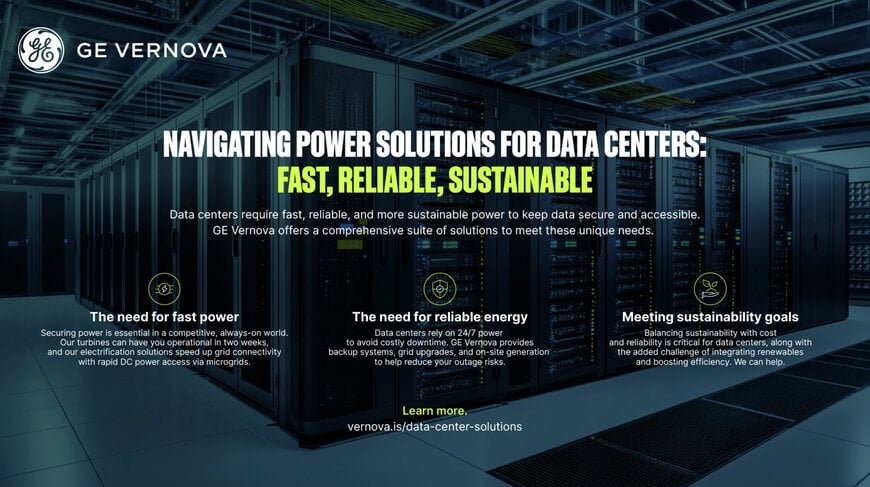
GE Vernova has presented an energy framework addressing the surging electrical demands of artificial intelligence and hyperscale data centers across Australia. The initiative focuses on deploying fast-ramping aeroderivative gas turbine systems alongside grid transmission technologies to provide dispatchable firming capacity for variable renewable generation and maintain grid stability across expanding digital ecosystems.
Electrification Pressures and Physical Grid Infrastructure Bottlenecks
Global electricity demand is projected to increase substantially by 2050, driven by the broad electrification of transportation networks, heavy manufacturing processes, commercial buildings, and high-performance computing clusters. While initial expansions in artificial intelligence concentrated on semiconductor architectures, processor cooling systems, and algorithm parameters, the primary barrier to operational scale has shifted toward physical grid infrastructure.
Scaling hyperscale computation requires substantial upstream electrical assets, including high-voltage transmission corridors, step-down substations, distribution transformers, gas-insulated switchgear, and fast-acting generation capacity. In Australia, data centers represent high-utilization, continuously operating baseload loads. Without coordinated power planning, unmanaged digital loads risk destabilizing local utility networks. Conversely, structured digital infrastructure investments provide anchor off-take agreements that finance grid upgrades, accelerate substation construction, and de-risk network expansion.
Fast-Ramping Aeroderivative Turbine Firming for Variable Renewables
Australia’s ongoing energy transition involves substantial capital deployment across Renewable Energy Zones, utility-scale photovoltaic arrays, onshore wind assets, and battery energy storage systems. Because wind and solar output fluctuate with weather conditions, preserving system security demands dispatchable firming capacity capable of mitigating rapid supply deficits.
Aeroderivative gas turbines serve as a dynamic balancing mechanism within this renewable-heavy generation mix. Derived from aviation turbine architectures, these units feature rapid-start capabilities and steep ramp rates that activate during renewable generation curtailments or sudden frequency fluctuations. By delivering quick-response peaking capacity and steady synchronous inertia, aeroderivative units balance intermittent renewable generation, preventing transmission volatility while maintaining continuous electricity supplies to mission-critical facilities.
Speed-to-Power Strategies and Rack-Level Systems Integration
Securing commercial advantage in the digital sector requires speed-to-power—the ability to connect, stabilize, and distribute power in alignment with aggressive construction schedules. Large-scale data center developers are shifting away from piecemeal component procurement toward comprehensive, end-to-end electrical architectures.
GE Vernova addresses this operational requirement by providing unified power-to-rack solutions that span utility-scale power generation, transmission equipment, automated distribution infrastructure, and network control software. Australia is positioned to leverage this integrated model due to its geographical proximity to East and Southeast Asian markets, substantial land resources, and landing points for international subsea fiber cables, which offer data transit routes without the land and freshwater constraints facing traditional Asian metropolitan hubs.
Additional Context:
This section details technical specifications and competitive benchmarking not included in the original product announcement
Within the aeroderivative firming category, the GE Vernova LM6000 platform represents the primary technical reference for fast-start peaking and grid-stabilization duties. The LM6000 simple-cycle gas turbine delivers an electrical power output between 53.9 and 57.1 megawatts with a simple-cycle efficiency of approximately 40.8 to 41.0 percent (lower heating value). Designed for rapid cycling, the unit achieves a full cold-start ramp to maximum base load within five minutes, sustaining ramp rates of up to 30 to 50 megawatts per minute, compared to 5 megawatts per minute typical of medium-speed reciprocating internal combustion engines. The dual-fuel system incorporates dry low emissions (DLE) or water-injected combustors and is engineered to operate on natural gas blends containing up to 100 percent hydrogen fuel.
In the 30 to 60 megawatt aeroderivative power generation class, the Siemens Energy SGT-A35 (formerly Industrial RB211) serves as an established industrial benchmark.
The Siemens Energy SGT-A35 delivers an electrical power output of 32 to 38 megawatts with an electrical efficiency of approximately 39.5 to 40.5 percent in simple-cycle configuration. The SGT-A35 utilizes a two-spool gas generator coupled to a free power turbine, incorporating an agile rotor architecture that eliminates hot lock-out periods, allowing immediate engine restarts from any shutdown condition without thermal cool-down delays. The platform reaches full power in under ten minutes and accommodates automated fuel changeovers between gaseous fuels and liquid distillates under load. While the SGT-A35 offers high power density and modularity for distributed industrial loads, the GE Vernova LM6000 provides higher single-unit power output (57 megawatts versus 38 megawatts) and a faster startup timeline (five minutes versus nine to ten minutes), facilitating larger block-load support for hyperscale campus interconnects.
Edited by Natania Lyngdoh, Induportals editor, assisted by AI.
www.gevernova.com
