
www.industry-australia.com
22
'22
Written on Modified on
Sewage sludge for the long haul
The good, old pneumatic post system could have been godfather to this pioneering technology. The specialist in progressive cavity pump technology, SEEPEX, developed a customized system solution, which combines the advantages of two conveying technologies in order to transport extensively dewatered sludge over long distances in a particularly energy-efficient manner. Smart Air Injection (SAI) compresses the sewage sludge into plugs, which are then ceaselessly boosted down pipelines up to 1,000 meters long using compressed air. This new alternative to conventional processes is already installed at a number of European plants and quickly pays off for wastewater companies.
Because of new technology, a long pipeline is no longer a disadvantage. This is currently more important than ever when it comes to disposing of dewatered sewage sludge. It is increasingly necessary to transport sewage sludge over long distances, e.g. to a phosphate recovery plant. Numerous advantages make the new system an interesting option for privately owned and municipal sewage treatment plants. The system not only meets the newest requirements with distances of up to a kilometer, but is also remarkably economical, because the total investment costs, follow-up expenses and operating costs are all comparatively low.
Sludge under pressure
For this system solution, the developer use a combination of pump conveying via a progressive cavity pump and dense phase pneumatic conveying. The new process requires only a cost-effective piping system made from plastic material, which not only plays a role when the system is bought new, but also whenever running expenses such as maintenance and operating costs need to be reduced. Another attractive feature is the low operating costs, which result from low energy consumption, long pump maintenance cycles of around two years and cheaper spare parts compared to other pumping processes. The time requirements for maintenance are minimal, at just a few hours, and can typically be performed by a single person without additional hoist/crane equipment due to the lower weight of components. Thanks to the ‘maintain in place pump’ design, the disassembly of the pipeline is not required. The lower pressure level additionally ensures an increased service life for the components and a reduced pump footprint. Plus, the automated system solution along with process monitoring, can be integrated into existing automation and control systems via conventional bus interfaces. All functional components, sensors and actuators are supplied as a complete package and are integrated into the control software.
For wastewater disposal companies the SAI system is an energy-efficient, high-performance alternative to conventional systems. As a customized conveying solution, it is engineered to fulfill the requirements of the plant and is parameterized on-site to optimize its energy consumption.
The challenge
Conveying dewatered sludge over long distances represents a major challenge for wastewater treatment facilities: the high viscosity and abrasiveness of the medium means that a significant pressure loss needs to be overcome in the conveying pipeline. In some cases, sequential pumping solutions such as belt conveyors or screw conveyors with multiple drive units are used. Because of their multiple drive units, these often exhibit high energy consumption and maintenance requirements. In addition, they are frequently designed to be open to the environment, which can result in unpleasant odors and rehydration by rainwater, and are inefficient for vertical or complex conveyer sections. Alternatively, closed piping can be used in conjunction with multi-stage progressive cavity pumps or in some cases piston pumps, which are particularly suitable for highly viscous media and high pressures. However, because of the large counter-pressure, they require comparatively high investment costs for pressure-resistant piping (in some cases more than PN100). Piston pumps in particular also have significant maintenance requirements and costs, long downtime during maintenance, and relatively high drive power and energy consumption.
The new pumping solution
The SAI system has no such disadvantages. In this system, a sludge plug is first compressed and compacted in the pressure line via a hopper pump, [see Fig. 1.a) and 1.b)], and is then conveyed onwards by means of pulsed, compressed air injection [see Fig. 1.c)]. The air injection is pressure-controlled via an algorithm optimized for the application (see Fig. 2). The pneumatically transported sludge plug is also enclosed in a polymer solution. This reduces friction in the pipeline, thus improving the energy efficiency of the system as a whole.
The combination of pump conveying and dense phase pneumatic conveying permanently reduces the pressure in the entire conveying pipeline to a very low pressure level, (see Fig. 2, maximum pressure approx. 4 bar). It results directly from the energy required to initially set the compressed sludge plug in motion. Once the static friction force has been overcome, the sludge plug is accelerated by the expanding compressed air flowing behind it, which again reduces the pressure level in the pipeline (see Fig. 2). Adjusting system parameters such as polymer flow and air flow on-site makes it possible to set a plant-specific, energy-optimized operating point.
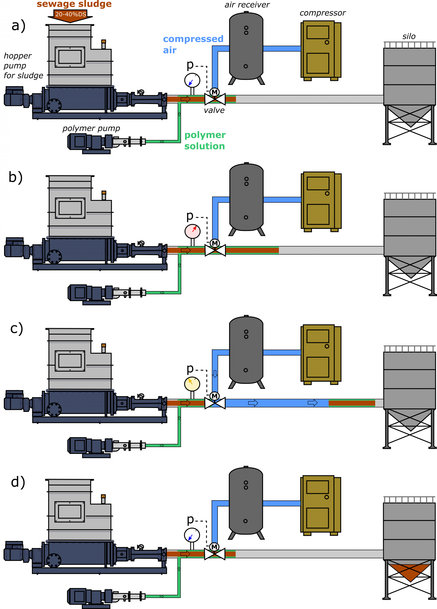
Fig. 1: Schematic illustration of the system’s conveying process for sewage sludge, using polymer injection and dense phase pneumatic conveying. a) Compression of sludge plug, until b) an optimized compression level is achieved in the pipeline. c) Open the compressed air valve in order to propel the sludge plug into the silo using compressed air. d) Pressure drop in the conveying pipeline.
The lower pipeline pressure allows considerably thinner-walled and cheaper piping to be used (PN10 to PN16), which results in significant reduction in investment costs, particularly over long conveying distances. In addition, smaller single-stage hopper pumps can be used with an optimized and patented maintenance technology, which reduces maintenance requirements to a minimum (rotor/stator replacement in under an hour) and has comparably low energy consumption.
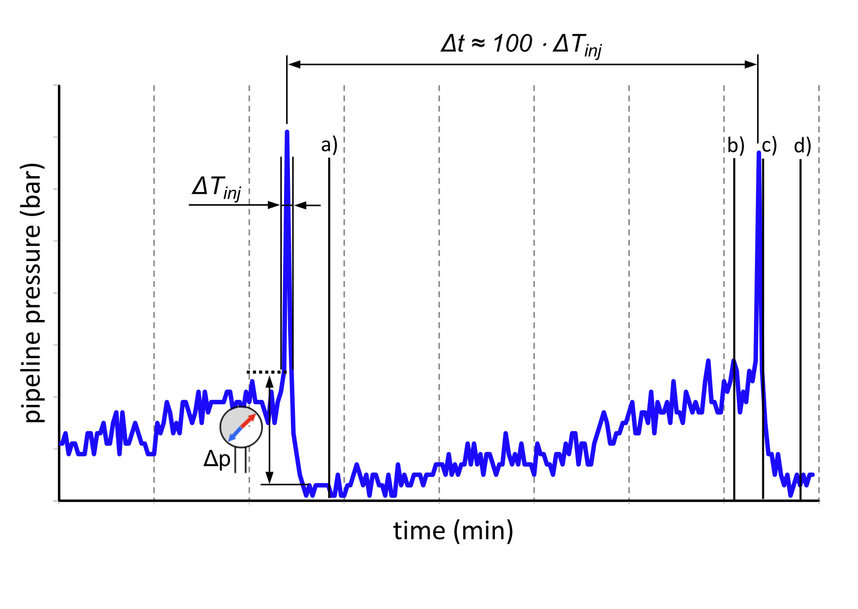
Fig. 2: Schematic pressure curve at the injection point of the sludge pipeline. When a predefined pressure level is reached, compressed air is injected for a few seconds, ΔTinj, after which the pressure in the sludge pipeline drops by Δp. The progressive cavity pump is then used over a period of several minutes, Δt, to pump a new sludge plug into the pipeline, until another compressed air injection takes place. The marked times a)... d) correspond to the conditions illustrated in Fig. 1.
The total system
The central element of the new system solution is the integrated control system, which regulates all functions of the total system. The filling level in the supply hopper of the sludge pump is recorded using a laser distance sensor or via load cells, and the conveying capacity of the sludge pump is adjusted depending on the fill level. The polymer flow is adapted relative to the current sludge flow, in order to minimize polymer solution consumption. Furthermore, the system is equipped with temperature, overpressure and frequency inverter monitors, which implement three safety functions to ensure smooth and safe operation of the total system. Depending on the circumstances of the conveying path, it may be necessary to inject compressed air and polymer solution into the piping at multiple points (see Fig. 3 for two injection points). The valves for injecting air can also be controlled manually via a control device with a display, which is included in the delivery. This is particularly relevant for cleaning the pipelines, e.g. before extended stoppages of the system or to clear blockages in the conveying pipeline.
The system parameters can be set in two different manners. On the one hand, (remote) control can be performed via fieldbus from a control center, or on the other hand the system parameters can be modified locally via a control device. Furthermore, the flow of compressed air and polymer solution is measured and displayed on the local display of the control panel alongside other important system information, e.g. the system status and pump operating parameters.
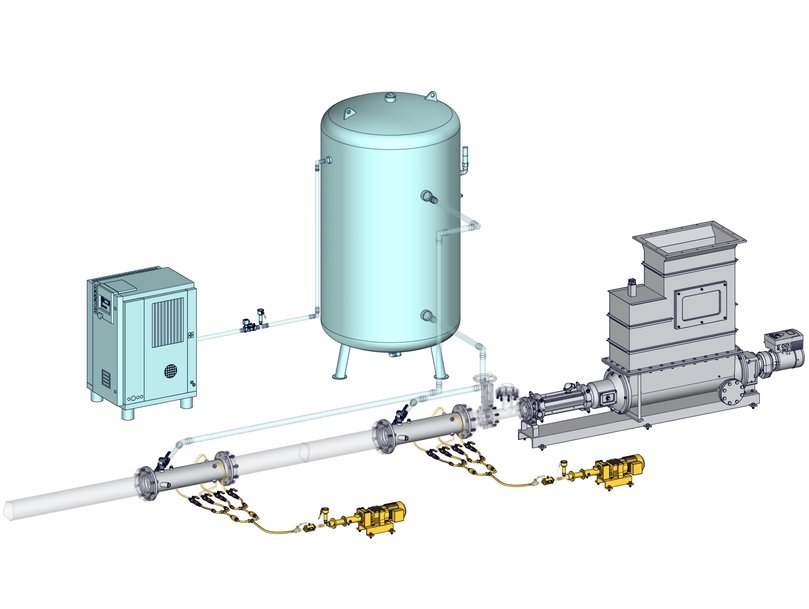
Fig. 3: 3-D model of the new system with two injection points for polymer solution and compressed air.
