
Compact Dual-Mode Ultrasonic Sensor for Robotic Mapping and Leak Detection
Fraunhofer IPMS and Cosys-Lab at the University of Antwerp develop PiCASo, a miniature ultrasonic perception sensor that combines active sonar environmental mapping with passive acoustic gas leak localization.
www.fraunhofer.de
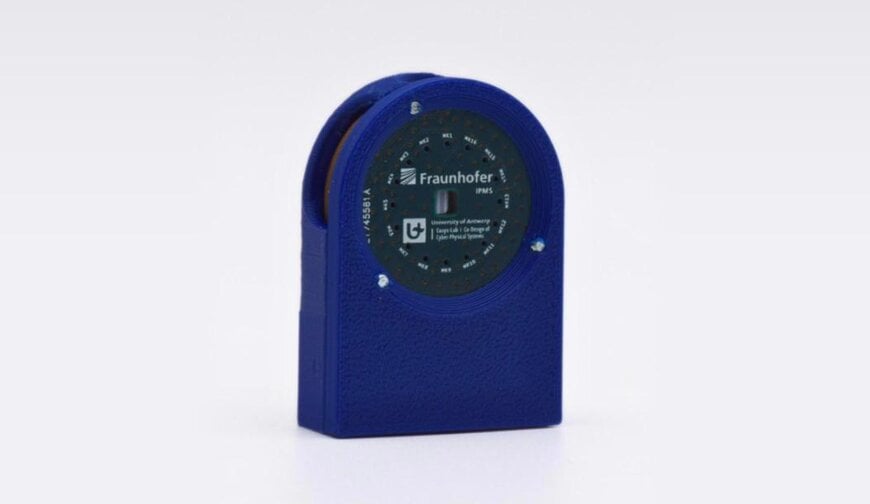
Autonomous mobile robots and industrial inspection platforms commonly rely on cameras and LiDAR systems for spatial navigation, yet optical sensors suffer severe performance degradation in environments characterized by airborne dust, dense smoke, fog, low lighting, or poor visibility. At the same time, industrial facilities require continuous condition monitoring to detect pressurized gas leaks that frequently escape visual inspection. Resolving both spatial perception and acoustic anomaly detection on size-constrained robotic platforms requires compact, multi-modal ultrasonic sensor architectures capable of operating across challenging environmental conditions without adding payload bulk.
Dual-Mode Acoustic Architecture and Miniaturization
To combine environmental mapping and condition monitoring in a single package, researchers at the Fraunhofer Institute for Photonic Microsystems (IPMS) and Cosys-Lab at the University of Antwerp developed PiCASo. Housed within a compact 35 × 38 × 15 millimeter enclosure designed for small robotic platforms, the sensor integrates a 4 × 4 millimeter micromachined ultrasonic transducer (L-CMUT) operating across a broadband frequency range of approximately 20 to 80 kilohertz alongside a circular array of 16 miniaturized digital microphones.
The sensor operates across two distinct functional modes:
Active Sonar Mapping: PiCASo emits broadband ultrasonic pulses and analyzes returning echoes to generate spatial acoustic images of surrounding obstacles and structures.
Passive Acoustic Localization: The 16-microphone circular array captures ambient ultrasonic emissions from the environment, enabling the system to pinpoint the spatial coordinates of acoustic anomalies such as pressurized gas leaks.
Experimental Validation and SII 2027 Presentation
In laboratory evaluations, the research team tested PiCASo on a compressed-air conduit containing three defined leak points, where the system successfully distinguished and localized all three leaks—including the smallest orifice measuring 0.3 millimeters in diameter. In active indoor perception trials, the sensor generated spatial acoustic maps at distances up to 6 meters, reliably identifying and locating walls, passageways, radiators, and surrounding objects.
Dr. Sandro Koch, Head of the Acoustic Sensors and Systems business unit at Fraunhofer IPMS, stated that the development focused on packing maximum sensing capability into minimal space, demonstrating how broadband ultrasound enables compact autonomous systems to map unfamiliar environments and navigate safely. Supported in part by the Federal Ministry of Research, Technology and Space (BMFTR) through the iCampus 2 project, the research will be presented at the 2027 IEEE/SICE International Symposium on System Integration (SII 2027) in Kobe, Japan, from January 11 to 14, 2027.
Additional Context
In ultrasonic robotic perception and industrial leak detection, Capacitive Micromachined Ultrasonic Transducers (CMUTs) replace conventional bulk piezoelectric crystals with silicon-fabricated micro-membranes, providing wider fractional bandwidth (20 to 80 kHz) and simplified CMOS integration without bulky acoustic matching layers. Combining a central emitter with a 16-element circular microphone array enables real-time beamforming and Time-Difference-of-Arrival (TDOA) direction-finding across both active echo ranging and passive ultrasonic turbulence detection—since pressurized gas escaping through sub-millimeter orifices generates broadband ultrasonic acoustic emissions peaking between 25 and 60 kHz due to high-velocity turbulent jet shear.
Within the robotic ultrasonic sensing and acoustic imaging landscape, PiCASo bridges the gap between basic single-pixel ultrasonic rangefinders (such as Bosch, Murata, or Pepperl+Fuchs industrial proximity sensors) and handheld industrial acoustic leak-imaging cameras (such as the Fluke ii900/ii910 series or Teledyne FLIR Si124, which utilize large 64- to 124-microphone arrays). While 3D ultrasonic sensors like Sonair's ADAR focus primarily on safety-rated volumetric obstacle detection, integrating broadband active sonar mapping and 16-channel passive leak localization into a 35 × 38 × 15 mm package equips compact inspection drones and mobile robots with combined navigation and predictive maintenance capabilities.
Edited by Romila DSilva, Induportals Editor, with AI assistance.
www.ipms.fraunhofer.de
