
www.industry-australia.com
24
'26
Written on Modified on
Back Contact Solar Modules for Utility-Scale PV in Australia
LONGi supplies 176 MWdc of Hi-MO 9 HPBC 2.0 modules to OX2's Muswellbrook Solar Farm on a rehabilitated coal mine.
www.longi.com
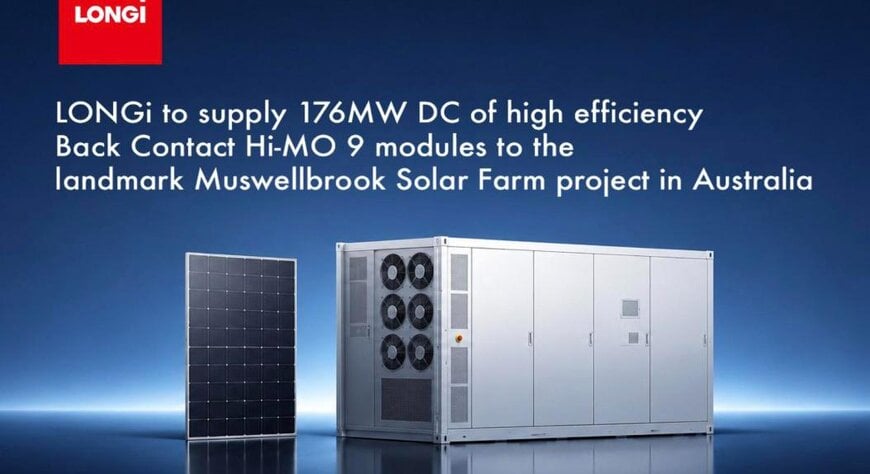
Replacing retiring coal capacity with utility-scale solar requires modules that sustain high energy yield under intense irradiance and high ambient temperatures. LONGi will supply 135 MWac / 176 MWdc of Hi-MO 9 back contact photovoltaic modules to the Muswellbrook Solar Farm and battery energy storage system (BESS) in the Upper Hunter region of New South Wales, a hybrid utility-scale project built on a rehabilitated former coal mine.
Utility-Scale Solar and Storage on Former Mining Land
The Muswellbrook Solar Farm and BESS is developed by renewable energy developer OX2. PV engineering, procurement and construction (EPC) is led by a joint venture between Bouygues Construction Australia and Equans Solar & Storage. Construction began in May 2026, with full commissioning and grid connection expected in 2028.
The plant occupies 482 hectares of rehabilitated mining land and combines a 176 MWdc solar array with a 100 MWh battery system. Approximately 300,000 LONGi modules are projected to generate around 347 GWh of electricity per year, equivalent to the consumption of approximately 52,000 Australian households, while avoiding about 300,000 tonnes of CO2 equivalent emissions annually. Up to 200 jobs are expected during peak construction.
Why Hybrid Solar Plus Storage Matters for the NEM
Australia has some of the highest solar irradiance levels globally and is integrating large hybrid solar and storage assets into its National Electricity Market (NEM). Pairing PV generation with battery storage allows daytime solar output to be shifted to periods of peak demand, supports grid stability and helps replace dispatchable capacity as coal plants retire. In this configuration, module energy yield and long-term degradation directly determine how much energy is available for storage and dispatch over the asset's lifetime.
How HPBC 2.0 Back Contact Technology Works
The Hi-MO 9 is a bifacial module based on LONGi's HPBC 2.0 (Hybrid Passivated Back Contact) cell technology and Tairay silicon wafers. In a back contact cell, all positive and negative electrical contacts are moved to the rear side. This removes metal grid lines and busbars from the front surface, so no part of the light-receiving area is shaded by metallisation. The zero-busbar (0BB) front design increases the active area exposed to sunlight, which is the main mechanism behind the higher conversion efficiency of back contact architectures.
Key Technical Specifications of the Hi-MO 9
According to LONGi, the Hi-MO 9 reaches module efficiencies of up to 24.8%. The module has a temperature coefficient of -0.26%/°C, meaning power output falls more slowly as cell temperature rises, which is relevant for Australian summer conditions where module temperatures frequently exceed standard test conditions. The module is covered by a 30-year power warranty, with an annual linear degradation rate that LONGi states is 0.05 percentage points lower than standard n-type products, corresponding to 1.5% more power after 30 years. LONGi also reports extended power generation in low-light conditions at dawn, dusk and during cloud cover.
Leon Zhang, President of Utility Europe at LONGi, said: "Our back-contact technology is uniquely designed to deliver maximum energy yield and long-term value, even in challenging environments."
Operational Benefits for Utility-Scale PV Plants
For utility-scale solar farms, higher module efficiency reduces the number of modules, mounting structures and cabling required per megawatt, lowering balance-of-system costs and land use per unit of output. A lower temperature coefficient limits midday power losses in hot climates, while lower degradation preserves output over the plant's operating life. Improved low-light response extends the daily generation window, which supports more consistent charging of the co-located battery system.
Additional Context:
This section details technical specifications and competitive benchmarking not included in the original product announcement.
Most utility-scale projects currently use n-type TOPCon (Tunnel Oxide Passivated Contact) modules, which retain front-side contacts and have also advanced rapidly; JinkoSolar's Tiger Neo 3.0, for example, reaches module efficiencies of up to 24.8% with a temperature coefficient of -0.26%/°C, according to the manufacturer. Back contact technology is also offered by other manufacturers; Aiko, for example, presented an all back contact (ABC) module with a reported efficiency of 25.2% at Intersolar Europe 2024. As leading back contact and TOPCon products now reach similar headline specifications, performance in the field depends largely on climate, mounting configuration, system design and the specific products installed.
Edited by Natania Lyngdoh, Induportals editor, with AI assistance.
www.longi.com
