
www.industry-australia.com
12
'26
Written on Modified on
Baumer launches fully reinforced encoders with smart features
The new range of fully reinforced encoders combines enhanced robustness with configurable functions for speed and directional rotation monitoring, as well as diagnostics.
www.baumer.com
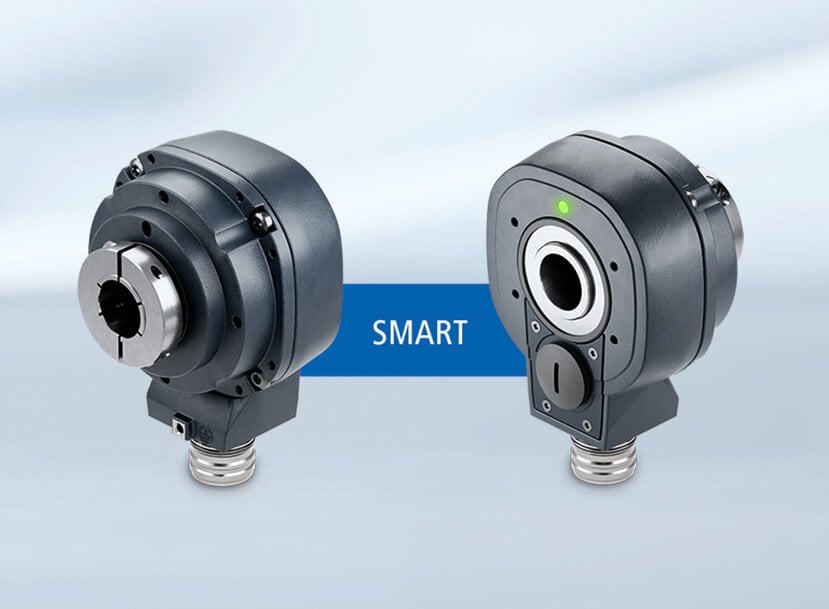
Industrial rotary encoders deployed on heavy-duty electric motors, brake motors, and synchronized conveyance lines routinely experience simultaneous environmental, mechanical, and electromagnetic stresses. In real-world factory and process environments, premature encoder failure rarely stems from a single isolated defect; instead, it arises from the cumulative interplay of high-frequency mechanical shocks, stray shaft currents generated by variable frequency drives, intense ambient magnetic fields, and bearing lubricant degradation. Historically, design engineers have faced difficult hardware compromises when specifying feedback devices. Standard industrial encoders frequently suffer bearing fluting from electrical discharge or signal distortion near electromagnetic brakes, while specialized heavy-duty encoders often sacrifice angular resolution or rely on plastic shaft-insulation sleeves that compromise mechanical concentricity and dimensional stability. Addressing these overlapping operational hazards requires a holistic encoder architecture that unifies long-life mechanical isolation, high-voltage shaft insulation, strong electromagnetic shielding, and onboard condition monitoring within standard imperial and metric mounting form factors.
Multi-Domain Resilience and Mechanical Longevity
To eliminate premature feedback failures in demanding automation environments, Baumer introduced the Fully Reinforced Encoders family, available in two regional shaft configurations: the HS35 compliant with United States imperial inch standards and the EN780 built to metric specifications for European and Asian markets. Rather than optimizing for a single isolated environmental rating, the platform is engineered to withstand the combined interaction of mechanical vibration, electrical interference, and thermal stress, delivering a typical service life of 10 to 20 years—approximately double that of comparable industrial models.
Mechanical durability is achieved through large-diameter ball bearings, specialized high-stability greases, corrosion-resistant surface coatings, and physically separated bearing and sealing chambers. Separating the seals from the bearing raceways reduces frictional heat transfer into the lubricant, lowering operating temperatures and extending grease life. To verify resilience against harsh mechanical transients—such as electromagnetic brake motors that generate high-frequency shock loads up to 10 kHz and accelerations of several thousand g—Baumer validated the series under real operating profiles across one million braking cycles rather than relying solely on conventional low-frequency laboratory shock tests.
Electrical Isolation, Magnetic Immunity, and Smart Diagnostics
On the electrical and electromagnetic front, the HS35 and EN780 protect against overvoltage, electrostatic discharge, and installation wiring faults common in modern inverter-driven systems. Integrated shaft insulation isolates the electronics against stray shaft voltages up to 2.8 kV without using plastic inserts, preserving strict mechanical concentricity and radial accuracy. High-power differential output drivers ensure clean signal transmission across cable runs up to 350 meters without external signal repeaters, while internal shielding provides magnetic field immunity up to 120 mT to maintain signal integrity directly adjacent to high-power drives and holding brakes.
For streamlined commissioning and lifecycle maintenance, the encoders feature direct USB-C parameterization, eliminating proprietary programming cables or hardware adapters. Using the freeware Baumer Sensor Suite software, engineers can visualize real-time speed and position waveforms, configure output and switching parameters, access electronic device identification, and inspect diagnostic event logs for condition monitoring. An integrated LED indicator provides immediate visual status for limit monitoring, while optional onboard monitoring functions track overspeed, underspeed, standstill, and rotational direction, transmitting limit status directly to programmable logic controllers via dedicated switching outputs.
High-Precision Feedback for Synchronized Motion Control
Beyond physical durability, the HS35 and EN780 deliver high-resolution feedback for closed-loop speed and synchronization tasks across packaging machinery, heavy material handling conveyors, and electronically coupled drive axes. The encoders achieve an angular accuracy of plus-or-minus 0.014 degrees (plus-or-minus 50 angular seconds) and maintain approximately one percent speed precision at rotational speeds as low as 10 revolutions per minute. Furthermore, the internal sensing architecture reliably detects mechanical standstill within a narrow creep window of 0.1 degrees, preventing unintended shaft drift during critical machine states. For extreme heavy-duty environments requiring even higher mechanical load ratings, Baumer continues to complement this series with its Hübner Berlin HeavyDuty product line.
Additional Context
This section details technical specifications and competitive benchmarking not included in the original product announcement.
In industrial motor and drive engineering governed by standards such as IEC 60034-17 and IEC 60034-25 for converter-fed AC motors, high-frequency pulse-width modulation switching from modern insulated-gate bipolar transistor and silicon carbide inverters generates parasitic common-mode voltages. These voltages couple capacitively across motor stator windings onto the rotor shaft, creating shaft-to-ground potential differences that discharge through the lowest-impedance path—often the encoder bearings—causing electrical discharge machining, raceway pitting, and premature bearing failure. Conventional mitigation approaches rely on external insulated couplings or polymer shaft sleeves, which introduce torsional windup, radial runout, and thermal creep that degrade angular measurement accuracy. Integrating ceramic or insulated structural barriers directly into the encoder housing and bearing assembly blocks circulating shaft currents up to 2.8 kV while maintaining rigid mechanical coupling. Simultaneously, operating adjacent to spring-applied electromagnetic holding brakes exposes optical and magnetic scanning disks to stray magnetic flux densities exceeding 50 to 100 mT, which can saturate standard Hall-effect sensors or distort differential square-wave quadrature signals unless shielded by high-permeability mu-metal housings and hardened differential line drivers compliant with RS-422/HTL industrial transmission standards.
Within the heavy-duty and reinforced rotary encoder market, Baumer’s HS35 and EN780 series benchmark directly against established hollow-shaft and blind-shaft industrial encoders from Dynapar (such as the HS35R and HSD35 vector-duty series), SICK (including the DFS60 and DBS60 programmable incremental encoders), Pepperl+Fuchs (such as the RHI90 and heavy-duty hollow-shaft lines), HEIDENHAIN (Leine Linde 800 and 1000 series heavy-duty encoders), and Kübler (Sendix H100 and 5873/5883 series). While North American vector-duty mainstays like the Dynapar HS35R offer ruggedized housings and insulated shaft inserts for mill and crane duty, they typically rely on DIP switches or proprietary programming boxes for resolution adjustments and lack integrated USB-C diagnostics. Conversely, programmable mid-tier encoders like the SICK DFS60 offer flexible resolution programming but generally lack multi-kilovolt integrated shaft insulation and 120 mT magnetic immunity. By unifying U.S. imperial HS35 and European/Asian metric EN780 mechanical footprints with direct USB-C configuration, onboard standstill and overspeed switching outputs, and 2.8 kV shaft isolation, Baumer bridges the gap between standard factory automation encoders and specialized heavy-industry Hübner Berlin units.
Edited by Romila DSilva, Induportals Editor, with AI assistance.
www.baumer.com
