
www.industry-australia.com
20
'26
Written on Modified on
Software-Defined Automation Modernises Regional Water Treatment Infrastructure
Snowy Valleys Council deployed Schneider Electric software-defined automation at its Tumut Water Treatment Plant to replace end-of-life controllers and safeguard long-term operations.
www.se.com
Application Area: Software-Defined Industrial Automation and Infrastructure Modernization
Industry Sector: Municipal Water Treatment and Utilities
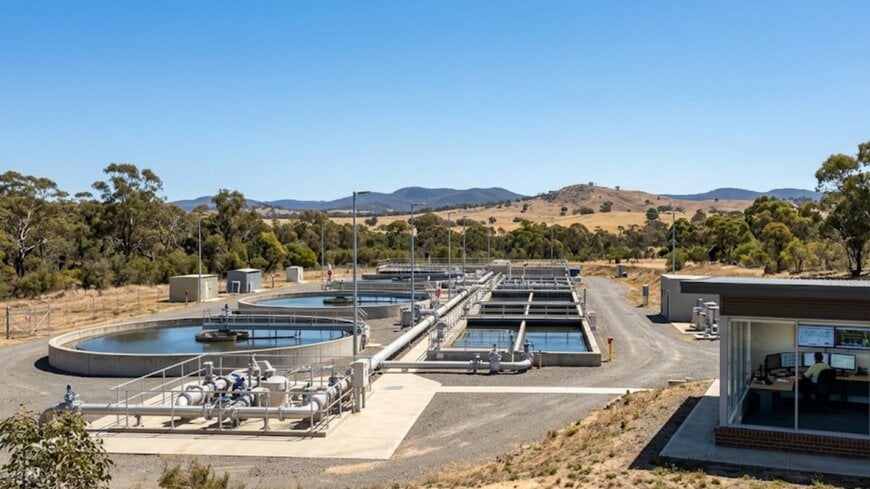
Operating in regional New South Wales, Australia, Snowy Valleys Council manages critical municipal water infrastructure, including the Tumut Water Treatment Plant. Active since the 1970s, the facility processes and supplies 16 million litres of potable water daily to the local community. Facing the operational risks of aging control hardware, the utility needed to replace obsolete, third-party programmable logic controllers (PLCs) at the end of their service life. Rather than executing a disruptive, full-scale hardware replacement, the council sought a scalable modernization strategy that would protect existing capital investments, maintain uninterrupted water delivery, and simplify future system upgrades.
Decoupled Hardware and Software Control Architecture
To eliminate hardware lock-in and support phased infrastructure renewal, Snowy Valleys Council partnered with Schneider Electric to implement an open, software-defined automation (OSDA) architecture built on EcoStruxure Automation Expert. Unlike traditional industrial control systems where control logic is tightly bound to proprietary hardware platforms, OSDA decouples automation software applications from the underlying physical computing and input/output (I/O) hardware.
This hardware-agnostic architecture enables control engineers to encapsulate process logic into portable, reusable software objects. As field instrumentation, controllers, or operational demands evolve over time, existing automation applications can be redeployed and adapted across different hardware targets without rewriting core code. By retaining functional legacy equipment while introducing standardized software-defined controls, the council established a flexible operational foundation capable of incremental expansion.
“Providing safe, reliable drinking water to our community is our priority. This project allows us to modernise Tumut Water Treatment Plant in a practical and cost-conscious way. It gives us a flexible foundation to meet the needs of our community well into the future,” stated Suman K C, Water Utilities Project Engineer at Snowy Valleys Council.
Engineering Validation and Phased Deployment
Schneider Electric collaborated closely with municipal engineers to integrate the software-defined control layer alongside existing plant assets, avoiding the cost and downtime associated with ripping out functional infrastructure. Prior to field deployment, the automation architecture underwent comprehensive off-site verification to validate control logic and system interoperability before transitioning to physical site installation and commissioning.
Accelerated Testing and Long-Term Investment Protection
During pre-deployment validation, the software-defined engineering workflow enabled the project team to complete factory acceptance testing (FAT) approximately 33 percent faster than originally scheduled—aligning with independent Frost & Sullivan research indicating 30 to 60 percent commissioning time and cost reductions for software-defined automation. By separating software lifecycle management from physical hardware lifecycles, Snowy Valleys Council preserved its engineering investment, reduced future upgrade complexity, and established a replicable modernization model for regional water utilities.
Edited by Romila DSilva, Induportals Editor, with AI assistance.
www.se.com
